Electroporation based Technologies and Treatments — International Scientific Workshop & Postgraduate Course
The meeting
Cell membrane electroporation, its mechanisms and applications in biology, medicine and biotechnology. The basis of the phenomena, current applications and future prospects were the main topics of this international meeting.
The postgraduate course was intended both for novices and experts in electroporation, including PhD students, researchers and users. Abstract submission was strongly encouraged and was necessary if credits (5 ECTS) were sought — each participant submitting an abstract was also required to give a short oral presentation of the work. This course was accredited also by the Medical Chamber of Slovenia, so active and passive participants received 20 CME credits.
Read all about EBTT in an article published by MediaResearch Ltd (2012). International Innovation is the leading global dissemination resource for the wider scientific, technology and research communities — more at www.researchmedia.eu.
University of Ljubljana · Institute of Oncology, Ljubljana · COST Action TD 1104
Chair: Peter Kramar
Members: Maša Kandušer, Matej Kranjc, Marija Marčan, Tadeja Forjanič, Duša Hodžić, Lea Vukanović
Course content
Resting & induced transmembrane voltage; dielectric properties of tissues; temperature & conductivity changes.
Electrochemical membrane thermodynamics; molecular dynamics simulations.
Protocols for electroporation of cells in vitro and in vivo.
Devices & electrodes for in vitro / in vivo work; tissue models & their experimental validation.
Basic mechanisms, preclinical studies, clinical use, current developments & future perspectives.
Gene transfection in vitro / in vivo; clinical use in human medicine.
Electroporation for gene delivery in the skin; DNA vaccines.
Colorectal liver metastases ECT; electrochemical processes in HV PEF; systemic ECT; food & biomass processing; MREIT field monitoring.
Faculty
Programme & schedule
Hands-on
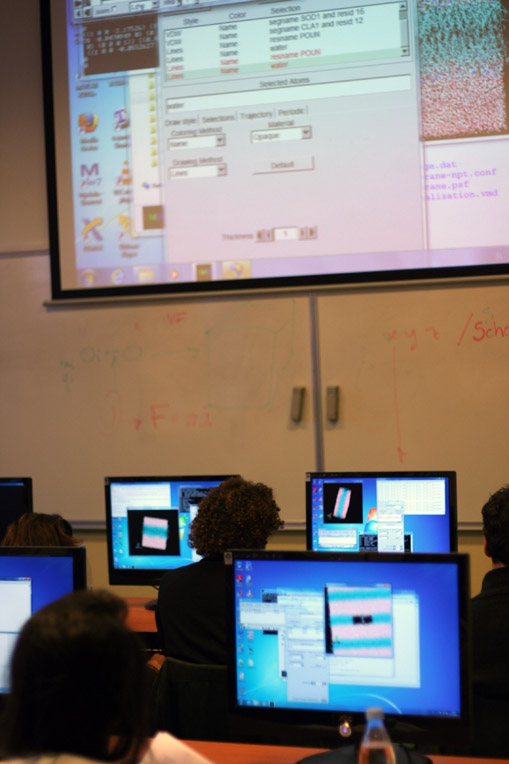
Wet-lab, computer-modelling and e-learning sessions. Participants selected up to three sessions from wet lab and modelling, plus computer simulation and e-learning. Exercise sheets (PDF) as distributed to participants.
| S1 | Laboratory safety | PDF ↓ |
| L1 | The influence of Mg2+ ions on gene electrotransfer efficiency | PDF ↓ |
| L2 | Monitoring cell membrane electroporation with ratiometric fluorescent dye Fura-2AM | PDF ↓ |
| L3 | Electropermeabilization detection with propidium iodide in plated cells | PDF ↓ |
| L4 | Measurements of the induced transmembrane voltage with fluorescent dye di-8-ANEPPS | PDF ↓ |
| L5 | Irreversible electroporation of bacterial cells | PDF ↓ |
| L6 | Electroporation of planar lipid bilayers | PDF ↓ |
| L7 | E. coli inactivation in a continuous flow system | PDF ↓ |
| L8 | Analysis of electric field orientations on gene electrotransfer — efficiency and visualization at the membrane level | PDF ↓ |
| L9 | Skin electroporation | PDF ↓ |
| C1 | Electrochemotherapy treatment planning: optimization of voltage & electrode position | PDF ↓ |
| C2 | Numerical modelling of thermal effects during irreversible electroporation treatments | PDF ↓ |
| C3 | Molecular dynamics simulations of membrane electroporation | PDF ↓ |
| E1 | Electroporation of cells and tissues — interactive e-learning | PDF ↓ |
Abstracts & publication
Workshop fee (630 EUR) included attendance to lectures, book of abstracts and course material, lunches and social events, and certificate of attendance and examination (5 ECTS credits and 20 CME if required). The postgraduate course was co-financed by the European Social Fund and the Ministry for Education, Science and Sport, in the framework of the Operational Programme for Human Resources Development 2007–2013.
Electronic proceedings — all abstracts and course material.
Download proceedings (PDF)Getting here
Held at the Faculty of Electrical Engineering, University of Ljubljana. Faculty floorplan (PDF)
Contacts